
Gael Force raises the stakes with SeaQureWeld
Gael Force Group has revealed how it has invested in a sector-leading quality assurance programme in the production of its HDPE fish farm pens while also implementing a series of design improvements.
Over the past three years, customer demand for their pen systems has increased markedly. The Group’s pen manufacturing business, Gael Force Fusion, has more than doubled its highly skilled workforce, and production and refurbishment works have expanded beyond their main base near Oban, with additional full-time manufacturing also taking place at Kishorn alongside longstanding remote build sites in Orkney and Shetland.
But while customer demand has been developing, so too has Gael Force’s desire to ramp up its focus on delivering world-class levels of quality assurance.
“We have completely raised our game by investing heavily in several areas to reinforce our quality assurance process for the design and build of pens. The prime goal for us is to offer a best-in-class standard of manufacturing excellence and quality assurance that fish farmers should expect; the gold standard in the sector.” Gael Force Group Production Director Stephen Offord explained.
Underpinning this unique quality assurance programme is an ISO 9001:2015 accredited quality management system and a purpose-built QHSE software platform. Gael Force has also been recommended for NS9415 certification by the leading Norwegian certification body, Aquastructures. These are critical foundations for formalising strict pen build procedures, monitoring plant and machinery, and supporting the continuous skills and training development of their workforce.
 At the heart of the programme is SeaQureWeld – a stringent process for assuring the highest standards of quality in the butt fusion welding of HDPE pipe joints during pen assembly. Highly specialised weld inspection equipment is used to perform quality tests on every weld bead produced from butt-fused pipe joints. The process is used over and above the requirements set out in the polyethylene standard WIS 4-32-08 which only requires the removal and hand testing of weld beads. The weld inspection equipment allows further in-depth testing and analysis of the external weld bead created during butt fusion and identifies defects at a higher level within the joint with pinpoint precision and accuracy.
Detailed individual weld logs are filed per project on the accompanying specialist database on the cloud, ensuring maximum traceability. In the unlikely event of a defect, the weld inspection equipment, which is controlled with a tablet and smartphone app, immediately detects this, and automatically triggers an email alert which is sent instantly to the supervisor and production manager. The section of pipe containing the defect weld is cut away and removed, data recorded in the app and sent for independent weld analysis. The weld is then completely re-done, and the testing process begins again until a pass result is returned on the next bead.
The important outcome from this highly rigorous testing process is that an unsatisfactory weld will not be permitted to leave the manufacturing area and, most crucially, will never make it into the pen assembly stage.
Stephen Offord says, “SeaQureWeld is on a different level from anything we have seen in the market and is going to offer customers added confidence in our pen building procedures. Our team, to their credit, have worked extremely hard to embed our robust quality assurance process into their daily routines and we are seeing that pay off for our customers”.
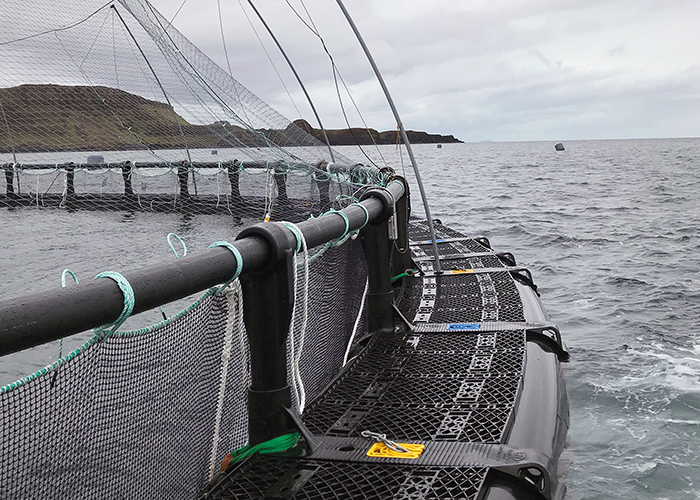
As part of the quality assurance programme, the fully integrated SeaQurePen 500 and SeaQureLift winch system have been reinforced through design improvements identified from user feedback on the harshest sites.
One recent design improvement is creating added stability for the deck and overall pen structure with the design of heavy-duty saddle welded stops to prevent movement of the base units on the 500mm floatation rings.
The SeaQureLift winch, designed for many years of reliable service in the marine environment, has undergone design improvements too, with additional protection to the winch motor which is rated to IP69K. Motor terminals are potted with a compound to prevent water ingress and moisture. On-pen installation of electrics has been hugely simplified with the removal of junction boxes on winch installations which means an improvement in reliability and reduction of clutter on the wide walkways. This significant design change also means an electrician is no longer required to carry out an on-pen installation. A frame reinforcement solution has also been designed to improve winch stability on the pen’s deck under the heaviest of loads.
Post written by:
Marc Wilson
For more information, visit: www.gaelforcegroup.com