
Warm Highlands welcome for biggest yet Aquaculture UK
Record numbers of visitors attended Aquaculture UK in Aviemore last week for a bigger than ever exhibition, packed conference programme and first-class networking opportunities.
In glorious Highlands sunshine, the aquaculture community made the most of the biennial get-together, the favourite meeting place for farmers, their suppliers, scientists, students and an exciting range of technical innovators.
The importance of the trade show in the sector’s calendar was highlighted by the attendance on day one of two leading Scottish politicians, who both came to support the industry and its contribution to Scotland’s and the UK’s economy.
Scottish employment and investment minister Tom Arthur – standing in for rural affairs secretary Mairi Gougeon – cited the £885 million the sector is worth, and the 12,500 jobs it generates, as he opened the event.
‘Aquaculture is a major contributor to our economy – providing well-paid jobs and careers, including for young people and particularly in our rural and island communities,’ he said.
Later, at an event hosted by sector body Salmon Scotland, Scottish Labour leader Anas Sarwar said salmon farming was a key part of ‘Brand Scotland’ and will play a significant role in his party’s economic plans if Labour gains power at Holyrood in 2026.
‘Food and drink should be viewed as an economic asset, and we need to build the right business environment in Scotland to help sectors like this thrive with responsible growth and high animal welfare standards,’ Sarwar told the gathering of industry decision makers. Aquaculture is already exporting around £700 million a year, ‘let’s get that up to £1 billion’, he added.
He also officially launched the Young Aquaculture Society (YAS) which, explained Scottish Sea Farms vet and YAS representative Alison Brough, aimed to ‘bridge gaps, connect minds and cultivate leadership by uniting young professionals’.
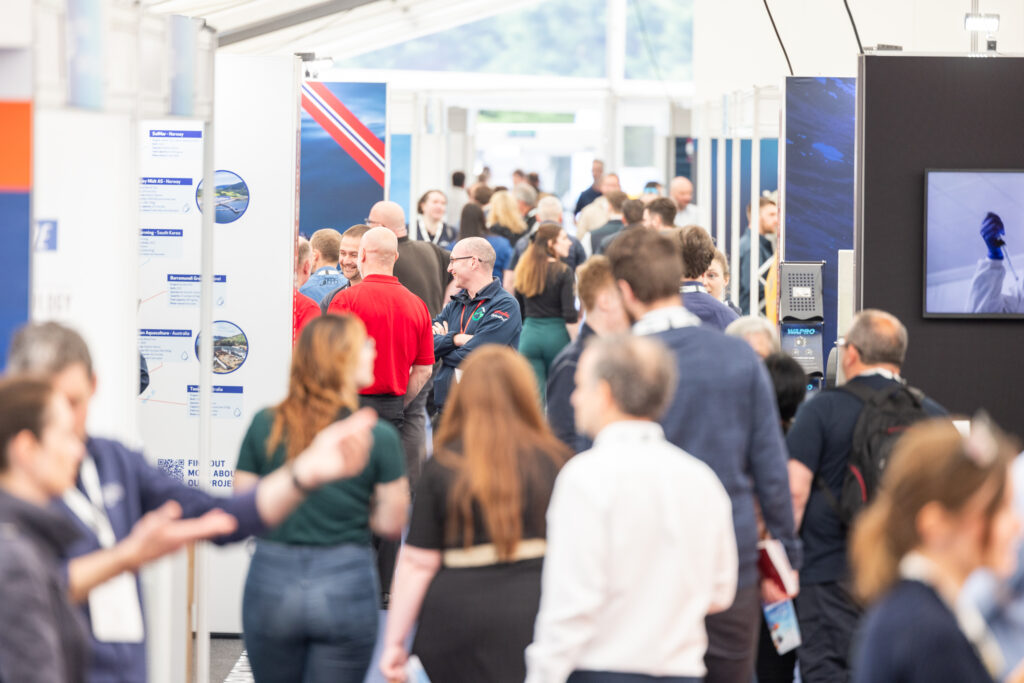
The Labour leader then toured the exhibition, stopping to speak to leading lights in the Scottish supply chain, including Hugh Murray of Migdale Transport, Stewart Graham of Gael Force, Paddy Campbell of BioMar and Brydon Barclay of Shetland based Flugga Boats, which brought to Aviemore the UK’s first 100 per cent electric coded workboat, built using renewable energy and attracting serious interest from visiting salmon farmers.
Barclay said ‘the time was right’ to introduce to the market the 7.5m E Flugga boat, with Evoy propulsion system, pointing out that a number of pioneers in electric propulsion were exhibiting at the show this year.
New technology was centre stage throughout the exhibition, from deep-tech start-ups applying AI and IoT to address aquaculture challenges, to heavy duty engineering innovations.
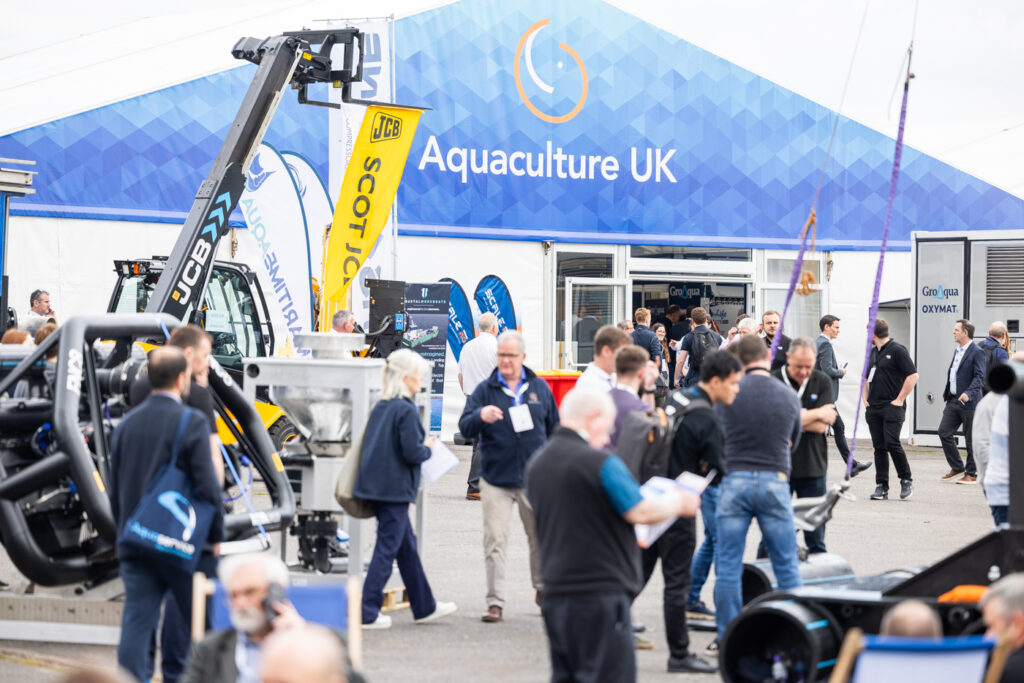
Aberdeen based Brimmond had to transport its 5.5 tonne NetJet to Aviemore two weeks ahead of Aquaculture UK so the exhibition space could be constructed around it, said the company’s Lisa Glenday Murdoch. But the effort was worthwhile as the high-pressure net cleaning pump, available as a rental option, proved to be a big attraction.
‘Aquaculture UK is very much the right audience for us. All the people we would like to have a conversation with are here and they can see the NetJet and talk to the team who designed and manufactured it.’
Aquaculture engineer Chris Jones of Norfab, who has been attending Aquaculture UK since its inaugural edition in Glasgow in 1986, thought this year’s event was ‘re-energised’ by the presence of such impressive displays of hardware, which reflected exhibitors’ confidence in the occasion.
For first time exhibitor Thermo Fisher Scientific of Paisley, which specialises in diagnostics and biotechnology services for businesses such as AquaGen and Pharmaq, the exhibition offered insights into the potential of aquaculture, its fastest growing market, said the company’s Joseph Kachali.
Also new to the show was the Chile Aqua & Food Tech Cluster, a delegation of eleven companies, including the Best Start-up winner at the Aquaculture Awards, ChucaoTech, which uses nanobubble technology to enhance fish health.
‘We have been made to feel very welcome,’ said Pablo Depich of the British embassy in Santiago, who met minister Tom Arthur at the stand. ‘We told him about the technical advances being made in Chilean aquaculture and he was very interested in collaboration between Scotland and Chile.’
Alongside the exhibition, the Keynote and Innovation theatres saw speakers and expert panels from across the sector discuss everything from alternative feed ingredients, the digital revolution, and gene editing, to water monitoring, energy consumption in land-based aquaculture, and decarbonising fish farming.
Singapore headquartered Umitron spelt out its mission to improve farm efficiency and environmental sustainability, with Scotland sales manager Russel Ferguson saying that with advances in satellite remote sensing and the ability of AI to analyse data, ‘the future was not far off’.
There was ground-breaking (literally) news from the Institute of Aquaculture which gave an update on the National Aquaculture Technology and Innovation Hub (NATIH) currently being built at its University of Stirling campus.
IoA head and NATIH director Professor Simon MacKenzie told a packed breakfast meeting in the Innovation Theatre that the state-of-the-art facility will open in 2025.
Meanwhile, Professor Dave Little announced that the IoA’s flagship MSc programme was being revamped to make it more relevant to the needs of Scottish and global aquaculture in the 21st century landscape, with the new course likely to be in place for the 2025 intake.
There was change, too, at the Sustainable Aquaculture Innovation Centre (SAIC), which revealed a new £1.5 million funding package on day one of Aquaculture UK and marked its ten years of innovation with a Keynote Theatre appearance on day two. In its first decade, SAIC had helped Scottish innovation become exportable globally, said CEO Heather Jones.
One SAIC supported project, now transforming fish health management, is blood sampling innovator WellFish. Over at its stand, business development manager and aquaculture expert Chris Mitchell said the show reflected the huge variety of the industry.
‘Aquaculture is a very broad church and getting broader every year, with people coming in from other sectors, and you can see that here, with the new cohort filling the boots of the old.’
Cheri Arvonio, event director of organiser Diversified Communications, said this year’s event had built on the success of previous shows.
‘The stars were aligned for a truly memorable two days in the Scottish Highlands and we’ve been overwhelmed by the positive feedback we’ve had so far from exhibitors and visitors.
‘Aquaculture UK goes from strength to strength and we are already looking forward to what the future brings as we plan for the next exhibition in 2026.’