
October 2025
As Trump’s tariffs continue to disrupt global trade, salmon producers push back, exploring new markets, innovative technologies and ambitious developments, writes Jenny Hjul in this month’s round-up of industry news
Volatile tariffs grabbed the headlines again this month, with Canada in the firing line once more when a row over Ronald Reagan (the 40th US president) prompted the current incumbent of the White House to slap an additional 10 per cent duty on his neighbours in the north.
It is not clear whether Canada’s $5 billion seafood trade with the US will be impacted by the new rate, imposed by Donald Trump on October 25 after the province of Ontario aired an anti-tariff advertisement featuring Reagan. The US had already imposed a 35 per cent levy on all Canadian goods – though there are some exemptions, including, to date, seafood.
Canada is ‘in the process of diversifying our trade relationships’, said Premier Mark Carney during the Association of Southeast Asian Nations (Asean) summit in Malaysia that both leaders were attending.
But Canada’s salmon farmers will be hoping Carney also turns his attention to their sector, particularly in beleaguered British Columbia. Aquaculture output has dropped to its lowest level in a decade, reported SeaWestNews, as a result of federal government actions to reduce salmon production in BC.
As Carney’s government plans to release its budget in early November, the Canadian Aquaculture Industry Alliance (CAIA) issued a list of demands, including that Ottawa replace its planned 2029 shutdown of BC salmon farms with a science-based regulatory model.
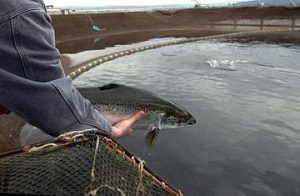
In the US, meanwhile, legislators across the political divide have introduced a bill that would make it easier to establish offshore fish farms, according to a Fish Farming Expert report. Pro-aquaculture lobby group Stronger America Through Seafood (SATS), which includes Democrat and Republican politicians, hopes the Marine Aquaculture Research for America (MARA) Act will help coordinate federal permitting for a US aquaculture programme.
‘Open ocean aquaculture would work in complement with our nation’s wild fisheries to help increase America’s seafood supply, create jobs across the seafood supply chain, and spur investment in coastal communities,’ said a SATS spokesman.
Strong blow
The US remains the biggest market for Chilean salmon but producers there are still battling Trump’s ten per cent tariff, introduced in April and described by Arturo Clement, president of sector body SalmonChile, as a ‘super, strong blow’.
However, there was a six per cent increase in Chilean salmon export volumes to the US in the third quarter of this year, attributed to a combination of lower prices, wider availability and promotional activities, Intrafish reported.
In the UK, Prime Minister Keir Starmer led a delegation to India to discuss details of the recent free trade agreement that will expand business between the two nations. The yet-to-be-implemented deal will reduce tariffs on seafood exports from 30 per cent to zero, opening up ‘exciting opportunities for the salmon sector’, said Salmon Scotland chief executive Tavish Scott.
While the Indian market is untapped, sales of Scottish salmon to Asia rose 60 per cent last year, driven by growth in China and Taiwan.
Norway in China
Demand in China also offset weaker results in the US for Norwegian salmon, which now holds 65 per cent of the Chinese market, up from 43 per cent, largely at the expense of Chilean exporters, reported Salmon Business.
Norwegian salmon has never been easier to buy in China, said Intrafish. Thanks to an explosion of digital platforms, delivery apps, and live streamers who are selling seafood straight from their phones, salmon has become ‘China’s latest online obsession’.
Although Norway’s exports to the US would be stronger without Trump’s 15 per cent tariff and competitors are gaining ground, according to Norwegian Seafood Council analyst Paul Aandahl, sales are bearing up: total exports of Norwegian Atlantic salmon to the US were up two per cent in value and five per cent in volume in September compared with the same month in 2024.
Overall, Norway has exported 1.28 million tonnes of salmon so far this year, 15.9 per cent more than at the same time in 2024.
But Norwegian salmon farming companies are at loggerheads with the government over its regulatory protocols. A total of 21 producers, including Mowi and Lerøy, have launched a class action lawsuit against the Ministry of Trade, Industry and Fisheries in protest at the traffic light system they claim has cost them millions in lost production.
They are demanding that the ‘red lights’ – introduced to protect migrating wild smolts from salmon lice – be repealed and the government be held financially responsible.
The ministry earlier offered a compromise of sorts, with the announcement on October 10 of a ‘flexibility scheme’ that would allow farmers to reclaim their lost red-light biomass but only if they use closed containment technology to rear their fish.
‘The new scheme will contribute to the development of new forms of operation with a lower environmental impact than today’s open cages,’ said Norway’s fisheries and oceans minister Marianne Sivertsen Næss.
The strategy, being rolled out this autumn, applies initially to farmers in western Norway who were impacted under the traffic light system.
Already, manufacturers of closed containment systems are reporting a boost in sales. ScaleAQ said interest has increased in its new closed-cage concept Heimdall, launched at AquaNor in August, and it has signed its first contract with Hardingsmolt, a salmon farmer on Norway’s west coast, Salmon Business reported.
Consolidation in the Norwegian sector continued last month, with Mowi’s acquisition of Nova Sea approved, making the world’s biggest salmon farmer even bigger with an expected harvest volume of 597,000 tonnes in 2025.
Stirling moves
Back in Scotland, the Institute of Aquaculture (IoA) at the University of Stirling is looking for a new head following the departure of Professor Simon MacKenzie after nearly four years in the role. IoA veteran Professor Trevor Telfer is temporarily in charge as the Institute prepares to commission its £21 million freshwater research centre, the National Aquaculture Technology and Innovation Hub (NATIH).
The UK Agri-Tech Centre, which drives innovation in farming and aquaculture, has also seen a change at the top, with former M&S head of agriculture and fisheries sourcing Steve McLean appointed as its chief executive from January. The centre is behind a new initiative to establish an aquaculture innovation farm in Scotland and this autumn has been taking soundings from sector stakeholders.
In Shetland, plans are back on course for what will be Scotland’s biggest salmon farm. Scottish Sea Farms, the country’s second biggest producer, is proposing a 6,000-tonne farm off Fish Holm in the Yell Sound on Shetland’s east coast, and is seeking a permit for 12 pens of 160m circumference.
Although a farm has existed on the site in the past, NatureScot initially objected to the proposals, claiming the farm would impact three bird species.
The government agency has since agreed that there will be no adverse effect on the bird populations and withdrawn its opposition, after a survey showed there was a peak of just eight red-throated divers, five great northern divers, and no Slavonian grebes in the vicinity of the planned development.
Keep up to date with the industry’s top stories, all in our next news review.