Improving aquaculture sustainability and operations using satellite technology
Global seafood consumption has doubled in the last 50 years, due to population and income growths, and is expected to grow even further in the coming years. With the global catch of wild fish being stagnant due to unsustainable practices and climate change threatening the health of entire aquatic ecosystems, experts say virtually all new seafood will have to be farmed. To meet the world’s growing seafood demand, aquaculture’s ‘blue revolution’ faces significant challenges, mainly around sustainability and innovation.
Satsense Solutions uses cutting edge satellite remote sensing technology and geospatial analytics to provide a suite of solutions that enable aquaculture practices to be more environmentally friendly while improving the overall efficiency of farming practices.
The following is a summary of the solutions offered, along with the sustainability and operational benefits:
1) Farm Site Assessment
Individual farm locations, features and practices are assessed, using multispectral and high-resolution satellite imagery.
- Farm location is monitored to assess if it is situated in protected ecosystems, environmentally sensitive zones and in or near critical habitats for endangered species, as such farms are required to adhere to more stringent standards.
- Farm features such as coastal barriers, riparian buffers and corridors between farm boundaries are measured and assessment for type of land cover (vegetation, barren, etc.). Maintaining minimum prescribed widths for ecological barriers provide enhanced disease and predator control.
- Farm practices such as the use of settling basins and/or public waterways are assessed to ensure responsible handling and disposal of sludge and sediments. This provides greater oversight and can also be used to prescribe best industry practices.
Sustainability benefits:
+ Evaluate the presence of ecological buffers and barriers
+ Provide regulatory and accreditor oversight
Operational benefits:
+ Prescribed buffers and barriers provide enhanced disease and predator control
+ Identify scope for improved practices
2) Water Quality Assessment
Water quality is the most important factor affecting fish health and thus managing an optimum range (varying across different species) can help farms increase yield and improve productivity. In addition, monitoring and reducing effluence loads can help diminish adverse ecological impacts on receiving waters and thereby improving sustainability of farming operations. This service assesses water quality (chemical and physical conditions) in and around farms based on water’s inherent optical properties observed from multispectral satellite data. The service helps to determine concentrations of suspended solids and phytoplankton pigments, both important factors affecting fish heath and farming productivity. Other key water quality parameters assessed include transparency and colour.
Sustainability benefits:
+ Assess effluent loads discharged in receiving waters to ensure responsible handling and disposal of sludge and sediments
Operational benefits:
+ Helps maintain optimum water quality to promote fish health and performance
3) Farm Network Analysis
This service is used to quantify the proximity, density and connectivity of aquafarms within a region, and thereby helps coordinate Area Based Management (ABM). Using geospatial analytic tools such as Convex Hull Analysis and Nearest Neighbour Analysis, we are able to identify and determine farm networks. Neighbouring farms can achieve significantly improved results when coordinating management of diseases and biosecurity measures, in addition to the optimal use of resources and minimal use of chemicals and antibiotics. For accreditation bodies, a uniform index can be developed to serve as an indicator of ecological load.
Sustainability benefits:
+ Assess proximity of farms to mitigate environmental impacts of high-density farming
Operational benefits:
+ Coordinate Area Based Management practices for optimal use of resources and better disease control and biosecurity
4) Algal Bloom Detection
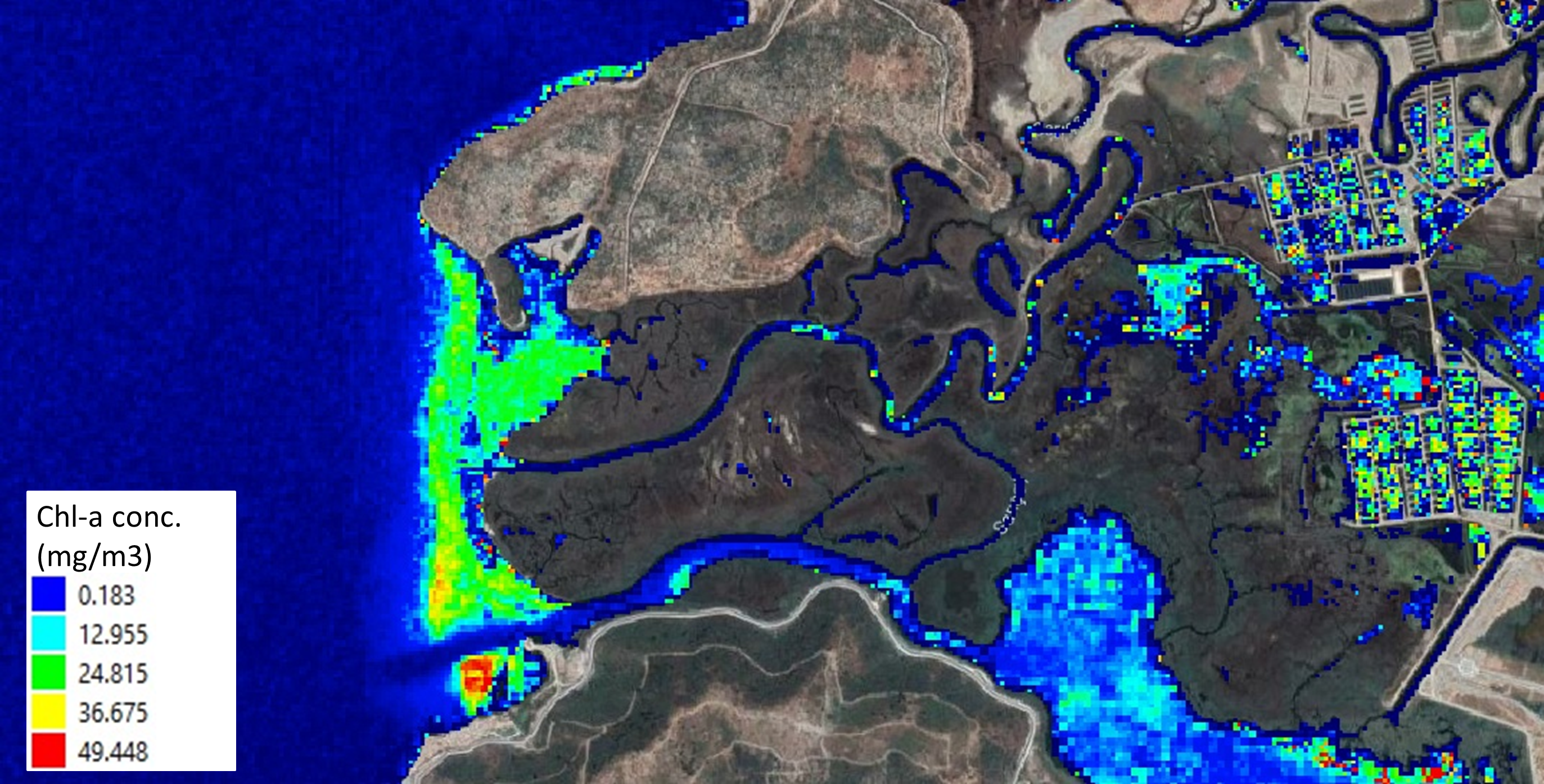
This service is used to identify eutrophication zones and provide early warning for the onset of Harmful Algal Blooms (HABs). HABs occur when colonies of algae grow out of control and produce toxic or harmful effects. This can lead to fish mortality, ecological degradation and human food poisoning through the consumption of fish. Using satellite data we detect algal blooms and measure Chlorophyll-a (Chl-a) concentrations. HABs are detected on the basis of Chl-a intensity and anomalies using recent historical data. An early warning system for the detection of HABs would allow aquafarms to take corrective action timely and help reduce fish mortality.
Sustainability benefits:
+ Monitor and prevent eutrophication
Operational benefits:
+ Early warnings for the detection of HABs in order to help reduce fish mortality
5) Land Use and Change Analysis
This service is used to assess land use and land cover changes in and around aquafarms over a period of time. The service can support environmental-impact analyses, by determining changes in land use or monitoring the rehabilitation efforts of ecosystems such as mangroves and wetlands. The service also supports social-impact analyses, by assessing land use and shared recourses, such as water bodies and coastal access with local communities. In addition, this service can check if aquafarms have adequate protection against extreme events, such as storms and floods, as well as risk from slow changing phenomenon, such as salt-water intrusion and coastal erosion.
Sustainability benefits:
+ Ecosystem protection and rehabilitation
+ Support Environment Impact Analysis
Operational benefits:
+ Warning against coastal erosion and salt water intrusion
+ Support Social Impact Analysis
Satsense Solution’s suite of services provide the following benefits:
a) Lower Cost
Reduced need for on-site visits, as certification standards and farming operations can be assessed through remote sensing, thereby incurring significant cost savings.
b) Proactive
Several services offer early warnings, allowing farms to take proactive steps rather than being reactive to an adverse event.
c) Comprehensive
Complete spatial coverage provided as entire areas of interest are assessed.
d) Efficient
Assessments can be carried out more frequently and easily, including those located in remote or hard to access areas. In addition, several sites can be assessed in a single instance.
e) Long-Term Sustainability Vision
The services contribute directly towards the UN’s Sustainability Development Goal 14: “Life Below Water” and the European Green Deal ‘’Farm to Fork” strategy, creating a virtuous cycle for sustainability and good farming practices.
f) Dual-Value Proposition
Each service contributes towards improving environmental sustainability as well as enhancing farming operations.
Post written by:
Nikhil Pasari
For more information, visit: satsense.co/aquaculture