
Monthly Round-up by Jenny Hjul – February 2025
Scotland celebrates record salmon exports and improved fish health, Norway is in consolidation mode, and the whole seafood world is on tenterhooks over the threat of Trump tariffs, writes Jenny Hjul in this month’s round-up of industry news.
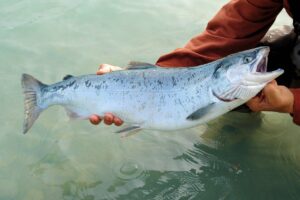
Scotland’s salmon farmers had several reasons to celebrate this month, with news of record exports last year and greatly improved survival rates across the sector.
Salmon remained the UK’s top food export as foreign sales increased by 45 per cent in 2024 to hit a record high of £844 million, beating the previous record of £618 million in 2019.
Sales to France accounted for 55 per cent of the value of exports, the US 27 per cent, while exports to Asia soared by nearly 50 per cent.
As the largest export by volume to go through Heathrow Airport, Scottish salmon warranted a special mention by Chancellor Rachel Reeves when she made the government’s case for a third runway at Heathrow earlier this month.
‘A third runway could increase trade opportunities for products like Scotch whisky and Scottish salmon, already two of the biggest British exports out of Heathrow,’ Reeves said.
Data from the past five years shows that 115,000 tonnes of Scottish salmon valued at £970 million have been exported from Heathrow, carried mostly in the hold of passenger flights.
The sector also announced greatly improved fish health in the past year, with mortality levels falling by more than a third.
Survival across all marine farms was 82.3 per cent, said Salmon Scotland chief executive Tavish Scott, who revealed the figures in an open letter to the convener of the parliamentary committee responsible for a recent investigation into salmon farming.
Salmon businesses had invested nearly £1 billion in fish health and welfare since 2018 said Scott as he criticised the report of the Rural Affairs and Islands committee (RAIC), published in January, for failing to reflect the sector’s significant progress in improving fish survival.
‘Rather than providing a focused suite of proactive recommendations that will help streamline regulatory oversight to support our sustainable development into the future, RAIC has produced an extensive set of recommendations, many of which will add further regulatory complexity and burden on salmon farmers,’ he told convener Finlay Carson.
The committee’s findings will be debated in the Scottish parliament at a date yet to be decided and, ahead of that, the Scottish government and Salmon Scotland will produce detailed responses to the RAIC recommendations.
Meanwhile, the biggest salmon businesses in the country reported buoyant results for last year. Mowi Scotland saw significantly improved biological performance, harvest volumes, cost, and earnings in 2024 and expects to harvest almost 40,000 gutted weight tonnes of salmon in Scotland in the first half of this year, according to Fish Farming Expert.
Scotland’s second biggest producer, Scottish Sea Farms, almost doubled its harvest volume and revenues in the last quarter of 2024 compared to the same period in 2023, and for the whole year made an operating profit of almost £40 million.
Better together
In Norway, fish survival also improved last year but is still below 2022 levels. The mortality rate in the seawater phase was 15.4 per cent, down from 16.7 per cent the previous year, but the Norwegian Veterinary Institute said it was ‘too early to say whether last year’s decline marks the beginning of a new trend’, Salmon Business reported.
The past few weeks have seen another trend, towards further consolidation in Norway’s sector. Mowi’s acquisition of a controlling stake in Nova Sea is a sign of things to come, reported Intrafish, as ‘smaller, family-owned producers are likely to be swallowed up by larger rivals’.
Mowi has agreed to pay NOK 7.4 billion (£528 million) to gain control of fellow Norwegian producer Nova Sea in a deal that would increase its annual production by 52,000 tonnes.
SalMar has completed the acquisition of a controlling stake in Knutshaugfisk this month and moved to consolidate its 37.5 per cent stake in Wilsgård, obtained after acquiring Norwegian salmon producer NTS and merging with NRS in 2022.
Arctic Securities Seafood analyst Christian Olsen Nordby predicted there would be further mergers and acquisitions within the Norwegian salmon farming sector, driven by the bureaucratic burden of the salmon tax on smaller companies and the biological advantages achieved by having fewer players in any farming area.
Trump tariffs
Being big will also help salmon farmers shoulder the fall-out from punitive trade tariffs, threatened by Donald Trump after his inauguration in January.
Intrafish reported that the EU, Norway and other countries (including the UK) are ‘on edge’ after Trump announced 25 per cent tariffs (later postponed for a month) on goods imported from Canada and Mexico, on top of tariffs already imposed on China.
Companies with a global spread, like Mowi, will be in a better position to withstand potential tariffs, by rearranging its export channels.
Mowi, which farms in seven countries and supplies the US from its farms in Canada and Chile, said it planned to ‘redistribute our volumes from our seven origins with respect to prevailing trade policies’.
Norway’s exports to the US rose almost 40 per cent in January compared to the same period last year and the country’s new finance minister, Jens Stoltenberg, as the former secretary general of Nato, said he planned to share his ‘experiences from international cooperation’ to head off a damaging trade war.
Innovation
In more positive news, aquaculture innovation advances apace, with investment to match. Mowi Scotland has announced a £8.5 million research project with the Roslin Institute to improve salmon health and welfare.
The initiative seeks to identify regions of the salmon genome associated with complex diseases, focusing on heart and gill health, and support efforts to selectively breed more robust fish.
In Norway, SalMar Aker Ocean made strides in its development of offshore aquaculture after winning regulatory approval for its Ocean Farm 2 at a new site 16km north of its existing Ocean Farm 1 facility.
The semi-submersible structure will be 70m high with a 120m diameter, slightly larger than its predecessor, Salmon Business reported. The facility will accommodate between three and four million salmon, with a permitted biomass of between 6,500 and 8,750 tonnes.
For something completely different, Dutch venture Pan Ocean Aquaculture plans to develop an ocean-going salmon-producing ship to grow and transport salmon across the world in a fully-enclosed aquaculture system.
The project, called Marinova, would draw water from underneath the hull, its creators told Intrafish. They hope the vessel, a 229m long, 32-m wide and 20m deep Panamax tanker, could eventually supply the US market with salmon on a weekly basis.
Keep up to date with the industry’s top stories, all in our next news review.