
A novel feed additive that reduces sea lice attachment by >60%
By Benedict Standen, dsm-firmenich Animal Nutrition
 Fish health and welfare is under the spotlight like never before. Indeed, the Norwegian government has aspirations to become a global leader in animal welfare and has set ambitious targets to achieve <5% salmon mortality by 2035. In 2024, the average mortality rate in Norway was 15.4%, down from 16.7% in 2023.
The Norwegian Fish Health Report (Fiskehelserapporten 2024, report 1a – 2025) documented that 57.8 million salmon died in the seawater phase in 2024, with around one-third of all mortalities coming from handling stressors and damages associated with delousing treatments. Largely due to record sea-surface temperatures, 2024 sea lice levels peaked at +30% higher numbers than the previous five years, which resulted in 3160 non-medicated treatments.
As well as biological costs, there are also significant financial costs associated with sea lice. This is connected to the direct cost of sea lice treatments and downstream impacts. Further, Norway operates a traffic light system, which is used to determine if farms are allowed to increase production based on lice impact on wild smolts. In recent years, more regions are moving from a low risk of sea lice to medium, or high risk, which limits the industry to grow (Figure 1).
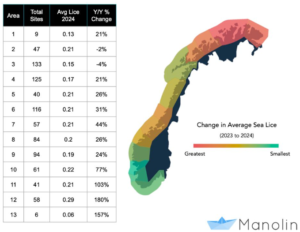
Figure 1: Regional performance differences in reported female sea lice figures across Norway’s production areas. PO 3 had the smallest change and PO 12 had the largest. SOURCE: Manolin Whilst there is no silver bullet solution, optimized nutrition and functional feeds have great potential to improve fish health and are being widely adopted in preventative healthcare strategies. Phytogenics are an exciting category of feed additives which when used in the right way can bring numerous benefits. In a recent trial at Stirling University, UK, a unique blend of essential oils (Digestarom® PEP MGE Aqua, Digestarom®) was tested to evaluate the anti-parasite effects under sea lice (Lepeophtheirus salmonis) challenge. Three doses of Digestarom® PEP MGE Aqua were tested, in addition to a control treatment. Atlantic salmon (Salmo salar) were supplemented with diets for six weeks, prior to the sea lice challenge (Figure 2).
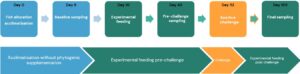
Figure 2: Schematic diagram for experimental protocol. Fish were acclimatized for a week, followed by six weeks of experimental feeding. Subsequently a sea lice challenge was applied with a final sampling after the lice had reached their adult phase.
To evaluate the effect of the feed additive on adult lice, fish were supplemented with treatment diets for a further 52 days, after which attached sea lice were counted. A statistically significant dose dependent response was observed, with lower numbers of lice attached to fish in the higher two doses, in real terms corresponding to a reduction of approximately 60%. No differences were observed at the lower levels of product supplementation, which highlights the importance of dosage. Further samples have been taken to elucidate the mechanism behind this benefit. When translated to the field, these results could lessen the sea lice pressure in salmon cages which in turn reduces the need for delousing treatments, improving fish health and welfare, and cost saving.